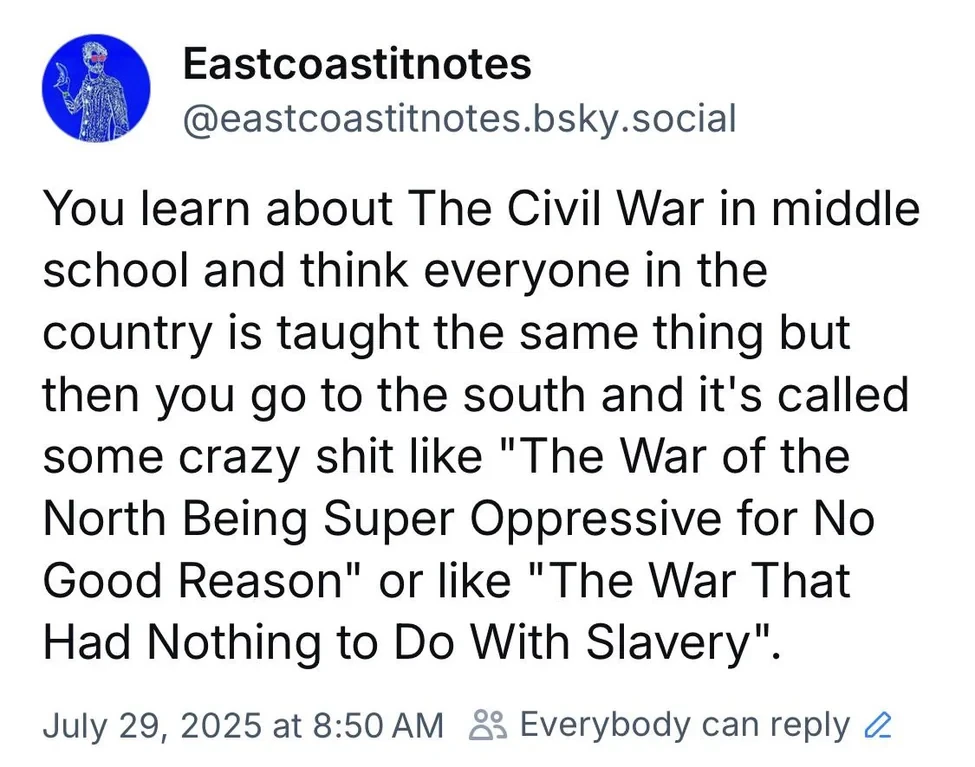
I want to dispell a misconception that keeps getting spread as a gotcha. It was never about states rights. No not even states right to slavery. It was about the preservations AND expansion of slavery. States did not and were not allowed to ban slavery. Read the consitution of the confederacy. It is almost a copy and paste of the US constitution but with minor changes that both empower and disempower the executive branch, but also banning the outlaw of slavery among one or two other slavery stuff. If it was about states rights to slavery, they would allow their states to ban it cause it would be their right to choose. But it was never that, they wanted slavery to expand. Even if you add the caveate of slavery to the “states right” myth, you are still perpetuating the myth. Just a less savory version of the myth.
The only way it was about states rights was how it was about establishing slavery as a right that could not be infringed.
Is the states rights issue when mentioned in any letters of secession, I wonder? Kinda doubt it…
But slavery is explicitly named as an issue in every single one, so yeah…
We recognize the fact of the inferiority stamped upon that race of men by the Creator, and from the cradle to the grave, our Government, as a civil institution, marks that inferiority.
-Jefferson Davis,
Our new government is founded upon exactly the opposite ideas; its foundations are laid, its cornerstone rests, upon the great truth that the n**** is not equal to the white man; that slavery, subordination to the superior race, is his natural and normal condition. This, our new government, is the first, in the history of the world, based upon this great physical, philosophical, and moral truth.
-Alexander Stephens,
Hard to dispute when it comes straight from the president and vice president’s mouth. Hard to believe anyone would pretend it was about anything else.
Not that I disagree, but is that just an aside, or did I miss an implication in the screenshot?
An aside, directed at the comments
Grew up in the South. Learned that it was a Civil War about slavery. What was taught was a brief overview, maybe at best a week, far more is covered now in a single Youtube video. And definitely didn’t learn about the darker parts of the war or the aftermath, including atrocities that happened locally to blacks who were managing to find a path from their days of bondage (Wilmington, Tulsa, plenty of others). I get that everything can’t be covered in grade school and often times the basics taught is not only the bare minimum but even incorrect because the details are far too many and are university level courses of their own. But I was shocked as an adult that someone wasn’t mentioned. The Civil War was almost glorified in the little we really learned.
I also grew up in the South, and my experience was also definitely a lot more limited and “both sides” coded than what I’ve heard from others I know who grew up in the north. Very much driven by the lost cause myth.
Slavery was billed as an unfortunate consequence of the South, lumped in with other “it was a different time” hand-waves of historical atrocities. The North was still sorta branded as the “good guys,” but in a way that implied the Civil War was still necessary for the North to realize its “neglect” of Southern issues. And Southern leaders (still enslavers all, but again, “different time”) were upheld as heroes who did the right thing by nobly fighting for their homes after the (again regrettable but still necessary) acts of secession. The “Union” and the Confederacy were basically framed like sports teams, with each side having pros and cons, and the Civil War was taught as a necessary reconciliation of their differences.
I also put “Union” in quotations because I learned more recently that even this type of language plays into the lost cause myth. It encourages people to think of the Union and the Confederacy as equal peers that emerged from a collapsed United States, and only by rejoining with the Union could the United States exist once again. The reality is that the United States never collapsed, and the aftermath of the Civil War was not a reunification, but the defeat of an unjust rebellion.
Defeat? The aftermath was the subversion of any attempt to hold the traitors responsible. Set everything up for the “business plot/coup”, which was a successful silent coup of the federal government. This country has always been fucked.
The war for states rights to enslave people
Texas still won’t admit the Alamo was about slavery. It explicitly was entirely about slavery. Texas went so far as to - twice - enshrine slavery into their constitution, and, even prohibit slave owners from emancipating their slaves.
That’s dedication. And when you look at Texas today, it’s after effects are everywhere.
I’m from rural illinois.
I recall some history teacher confusing the hell out of me in class.
She reiterated repeatedly that the civil war was not caused by slavery. But in the textbook it said it was.
And when it came time to take the test I was like…
Pretty sure it was about slavery. But I know she wants me to say it wasn’t.
So I checked it was about states rights. And I got it correct.
I remember this because I felt like I was being tricked.
It obviously was about slavery. I mean the whole thing with Lincoln and freeing the slaves.
But she said it wasn’t.
I wonder how many teachers like her are still around.
Yeah the Confederacy was against states rights. Member states were not allowed to be abolitionist. And they left the union because they weren’t allowed to force northern states to follow their laws. Anyone saying it was about states rights is a racist pos
My high school history teacher imparted the same thing.
He also explicitly went out of his way to note that the New Deal didn’t alleviate the Great Depression (but it was the war – and, therefore, production – which did) and had an entire lecture about how Nixon never thought he was doing anything wrong and name dropped that he knew certain members of that administration on a personal level so I don’t think he was exactly unbiased.
That said, he also spend more time on the 1940s civil rights movement than any other teacher I ever had and routinely highlighted that racial profiling was still prevalent in America so I’m not entirely certain what he had going on.
There are a lot of contradictory people out walking around.
Some even write books.
Lovecraft was apparently a racist, yet wrote about how the innsmouth fish people were unfairly discriminated against because of how they looked.
It’s just confusing to read because he was pretty racist but then insightful for his fictional discriminated fish people.
🤷
Orson Scott Card wrote about different species living as peaceful friends. And he is a homophobic piece of shit.
Right!? That guy.
Omg.
So the ender books. I had the audio book versions. I used to have a job where I could listen to books all day, so I did. And I can’t recall which book of his this was , it might have been Ender.but at the end there was an audio message from him. And I’ll summarize the main points.
-
You may have noticed that I (orson) voiced one of the characters in this audio book. That’s because I have a wonderful voice and the producers begged me to do it. Everyone knows I have an exceptional voice and way of speaking. I’m really just very good. (On and on he goes)
-
My ex wife is a bitch and so is her new effeminate husband. She never believed in me. She always held me back. Did I mention she’s a bitch ? (Honestly like 5 minutes of pure bashing on his ex. Maybe more).
-
I’ll never agree to have ender made into a movie because the producers keep wanting to give ender a love interest.
Ender is a child. Who’s trying to give him a love interest?
Hollywood producers. Apparently. They also did want to make him a teenage heart throb.
Which is a problem. Ender is a child. That’s important to the story.
-
They refer to it as “The War of Norther Agression” because the states just wanted to be free and have their own rights. Slavery had nothing to do with it.
When you ask them what they wanted the freedom to do the answer was always own slaves. Even the state constitutions stated it as a right.
War of northern aggression. Started by the South shooting at an American fort.
Germany did an amazing job teaching it’s people that Nazism was bad/regrettable. I really hope the US could teach some level of reflection to their population.
Ugh, no they didn’t. Or at least they don’t now.
20% of votes for the Nazis party itself, and a good 30% for the party saying we should “move past our history”.
Everything in this shitty country tries to play the “it was a long time ago” card.
And what do US students learn about the Alamo?
Funny enough, I was taught next-to-nothing about the Alamo growing up. I think it was mentioned maybe once in all 12 years of grade school. I don’t know that it has the same cultural currency it once did, at least outside of Texas.
We were taught largely that the Mexican-American War was started because of illegal immigrants from the USA going to then-Mexico and throwing a fit, including many Southerners who brought their slaves with them, and Mexico was cracking down on enforcement of anti-slavery laws.
To remember it.
But not to know why it happened, right?
I grew up in Texas in the middle of the countryside and we still learned about the civil war being southern states rights for slavery. Like, I have no clue what places are teaching what these morons are learning, but middle of nowhere Texas still taught it properly so 🤷
Also a matter of how up-to-date your textbooks are, and when you grew up. It was definitely common in the Deep South as recently as the 90s.
Even my community college American history class in 2002 (just an hour south of Atlanta) was chock full of Lost Cause nonsense.
I didn’t even recognize it at the time since it was the same stuff my dad taught me. He was a really smart guy who read a lot of history and was particularly interested in the Civil War, so I didn’t have a lot of reason to question things until later when I learned what the Lost Cause actually was.
It was always tied up in so many family stories too, and the idea of those 'damn yankees and carpet baggers", it was a part of my identity and history. It was just all around me, like the air, and so it was weird and kinda hard to unlearn that stuff, but not unwelcome.
I think maybe folks raised outside the south don’t see all that stuff, how that culture permeates everything. Or maybe they think it’s just a bunch of stupid rednecks who’ve never picked up a book, I’m never quite sure 😅
At least the more modern textbooks I’ve seen do a much better job at telling the proper story!
i still believe that slavery ended mostly because it’s expensive and inefficient. if you treat people like that they die after 3 years and you have to buy new slaves … meanwhile if you treat them better they live much longer and that’s much cheaper for the economy overall … so we have prison labor now which is the same thing but less abrasive.
That was an argument made at the time for those who wished to ‘let’ slavery die a ‘natural’ death.
I think such a point misses that the North and the South were not one society or even one economic system. Slavery perpetuates itself not because it’s economically efficient (it’s not, generally) but because it empowers elites who then leverage that power to preserve that power. They won’t let it go unless it’s torn from them - the North had the advantage of having never really been a ‘slave society’; slavery was permitted before it was banned, but slave-dependent elites were never a majority of power in the North.
It was always going to come down to coercion - whether through a prolonged struggle, or through the acquiescence of the slavers to an overwhelming threat of force. We had the former. I don’t think the latter would have been possible without the South being a much smaller proportion of the country, economically, demographically, and geographically.
Loved grandmother calling it the War of Northern Aggression.
Mother shut that shit down right quick though.
The war of southern aggression. Only started because the south wouldn’t let us free the enslaved people who entered northern states.