People can talk to strangers in public, we’re adults. If she tells him off then he should go away, but attempting to strike up a conversation doesn’t make someone a predator. Entitlement has nothing to do with it.
Your attempt to conflate the two concepts is what I think this other commenter is trying to draw attention to (albeit ineloquently).
You can’t know how a person will respond to an attempt to start a conversation before you attempt to start one, so by your logic no one should ever talk to anyone ever.
If a person doesn’t want to talk, they can say so directly (or more likely come up with some other excuse to evade it). But striking up a conversation in and of itself violates nothing.
The attitude that you are always in the right trying to have a conversation is entitled. Sometimes, you will be right, and sometimes you will be wrong. It’s up to you to be respectful when you are wrong.
It’s up to you to be respectful when you are wrong.
I never said otherwise. Show me where I said “If someone makes it clear that they don’t want to talk to you, you should force them into a conversation with you to assert your dominance.” You can’t, because I didn’t say that.
What I said was that there’s nothing wrong with trying to strike up a conversation, so whatever additional layers you’re trying to add onto that are merely strawmen.
What you’re saying sounds a lot like gaslighting. “You might be wrong without knowing it, but don’t feel bad about it! Just know that you were wrong, although I won’t tell you why.”
Being “wrong” implies moral agency. You’re not exercising moral agency if you’re doing something wrong without knowing it. I mean if the “wrongness” depends on knowledge that you don’t have access to, not if you just choose to not know better to carve out an exceptionalist place for yourself.
To illustrate, if a person hands you a pill and says “Give it to this person, because it’s medicine and they need it to live,” and you give it to the person but it was actually poison and they die, you didn’t commit the murder. The person who switched out the medicine with poison and then lied to you about it did.
Likewise, if you’re talking to a stranger in public and they’re being polite but deep inside they’re silently resenting you and wishing you would go away, you’re not doing anything wrong because there’s no way for you to read that person’s mind. If they want you to stop talking to them, they need to communicate that to you in some way or else it’s not an issue of morality on your part.
And it’s ridiculous that you’re trying to moralize that situation.
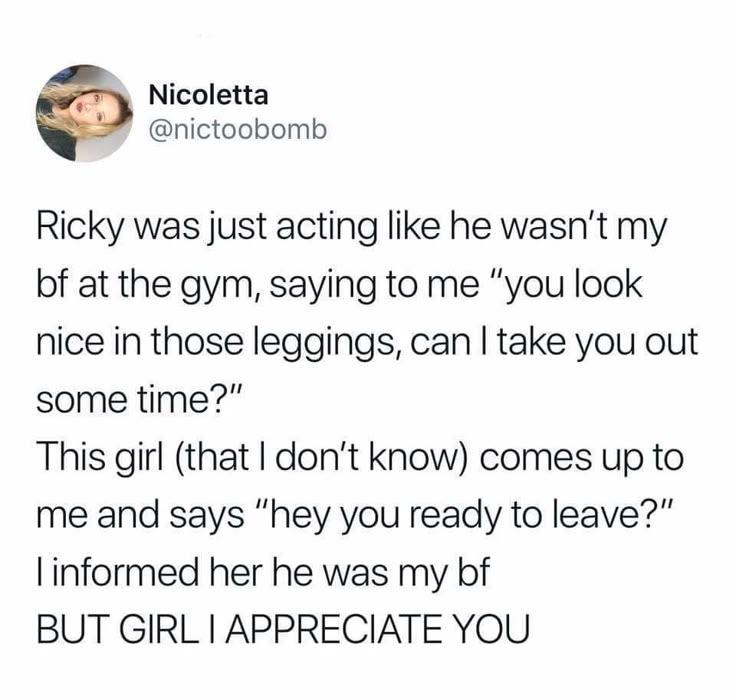
Who said anything about a conversation? This was an opener lame pickup line. Like I already implied in my original post, to assume they cannot take, “no” for an answer (and end of the convo) … is to assume the worst in people.
Interesting how you’re so willing to defend assuming the worst in others. Really says a lot about you…


Go ahead and keep contributing to the world’s problems by being a generalizing fool.
This is the same logic as the fucking morons that go, “It doesn’t matter who I vote for, they’re all corrupt” … and then vote for Trump.
Implying men are entitled to have conversations with women if they aren’t predators makes you seem like a predator.
People can talk to strangers in public, we’re adults. If she tells him off then he should go away, but attempting to strike up a conversation doesn’t make someone a predator. Entitlement has nothing to do with it.
Your attempt to conflate the two concepts is what I think this other commenter is trying to draw attention to (albeit ineloquently).
The attitude of “my intentions and want to start a conversation supersedes another’s right to avoid one” is the one of entitlement.
You can’t know how a person will respond to an attempt to start a conversation before you attempt to start one, so by your logic no one should ever talk to anyone ever.
If a person doesn’t want to talk, they can say so directly (or more likely come up with some other excuse to evade it). But striking up a conversation in and of itself violates nothing.
The attitude that you are always in the right trying to have a conversation is entitled. Sometimes, you will be right, and sometimes you will be wrong. It’s up to you to be respectful when you are wrong.
I never said otherwise. Show me where I said “If someone makes it clear that they don’t want to talk to you, you should force them into a conversation with you to assert your dominance.” You can’t, because I didn’t say that.
What I said was that there’s nothing wrong with trying to strike up a conversation, so whatever additional layers you’re trying to add onto that are merely strawmen.
Sometimes, there is something wrong trying to have a conversation. Just because you don’t know, doesn’t make it right.
Not to say you should feel bad about it or anything. You didn’t know.
What you’re saying sounds a lot like gaslighting. “You might be wrong without knowing it, but don’t feel bad about it! Just know that you were wrong, although I won’t tell you why.”
Being “wrong” implies moral agency. You’re not exercising moral agency if you’re doing something wrong without knowing it. I mean if the “wrongness” depends on knowledge that you don’t have access to, not if you just choose to not know better to carve out an exceptionalist place for yourself.
To illustrate, if a person hands you a pill and says “Give it to this person, because it’s medicine and they need it to live,” and you give it to the person but it was actually poison and they die, you didn’t commit the murder. The person who switched out the medicine with poison and then lied to you about it did.
Likewise, if you’re talking to a stranger in public and they’re being polite but deep inside they’re silently resenting you and wishing you would go away, you’re not doing anything wrong because there’s no way for you to read that person’s mind. If they want you to stop talking to them, they need to communicate that to you in some way or else it’s not an issue of morality on your part.
And it’s ridiculous that you’re trying to moralize that situation.
Who said anything about a conversation? This was an opener lame pickup line. Like I already implied in my original post, to assume they cannot take, “no” for an answer (and end of the convo) … is to assume the worst in people.
Interesting how you’re so willing to defend assuming the worst in others. Really says a lot about you…