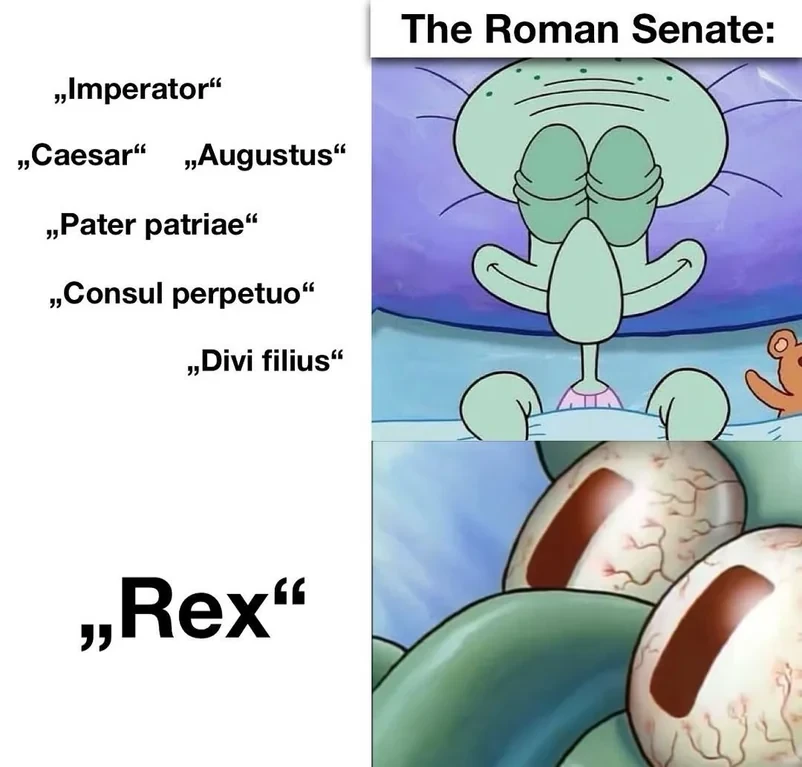

Explanation: For all the MANY titles Roman Emperors garnered over the years, ‘king’ was one that remained anathema in the Principate (the Roman Empire as we would recognize it), despite many other titles being… quite exalted.
The Emperor may have been the son of a deified god… but not a king! Never a king!
This was because of the foundation mythology right? Rome had a terrible king that they killed and set up the elected consuls as rulers instead (two at a time, a senior and junior, for a 1 year term). They swore to never again have a king, so even if the emperor was effectively a king, you couldn’t call him a king…
Yep, though there was also some ideological thinking behind it. To the Romans, the essential point of the Res Publica was that it was for the good of the public - hence the name. The Emperor, no matter how exalted, was still only a magistrate - everything he did, theoretically, was in the name of the power invested in him by the people. A monarch held power in their own right, in the same way that a citizen held power over their own property; the Emperor had no such (theoretical) power.
Funny enough, this would be the same basic reasoning used some 1800 years later by Napoleon when proclaiming himself Emperor of the French after a (dubious) plebiscite.
I sure am learning a lot by my sudden hyperfixation on this server
That’s what we’re here for! 🙏