
…That something has been named Phoebe. And working out what it actually is turns out to be one of the most intriguing puzzles in modern astronomy. The phenomenon at the heart of the story is called gravitational microlensing and it’s one of the most elegant predictions of Einstein’s general theory of relativity. When a massive compact object passes between us and a distant star, its gravity acts like a lens, briefly magnifying the star’s light in a very characteristic way. The shape of the brightening is distinctive and entirely unlike anything produced by a variable star, a flare, or an asteroid…
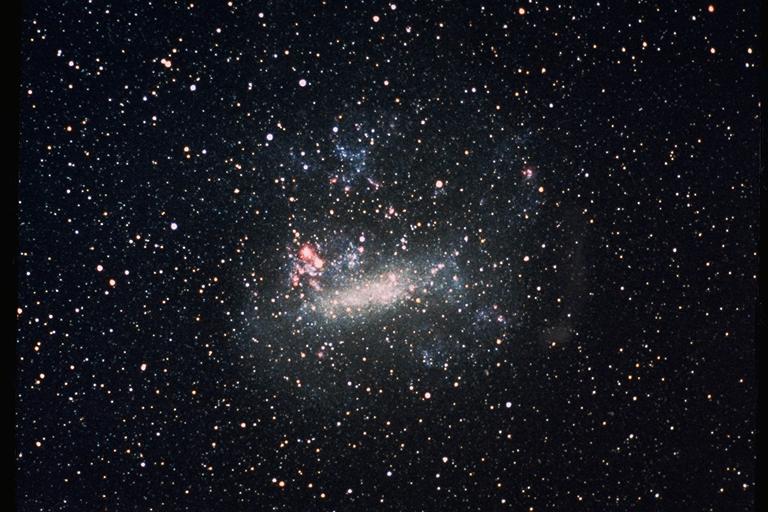
The team calculated the probability of the lensing object belonging to each possible population — Milky Way stars, Large Magellanic Cloud stars, or the dark matter halo between and around them. The dark matter halo wins by a factor of 100,000. Phoebe is five orders of magnitude more likely to be a dark matter object than anything associated with normal stellar matter…
The dark matter halo wins by a factor of 100,000. Phoebe is five orders of magnitude more likely to be a dark matter object than anything associated with normal stellar matter
Not sure why they suddenly swapped to using the term “dark matter object” for just this one paragraph, but what they’re talking about is a primordial black hole — something far less exotic than an object made entirely out of dark matter.
To be fair, primordial black holes are a candidate for explaining what dark matter is.
…There is a range of masses, , usually described as the ‘asteroid mass window’, where PBHs can make up all of the DM…
source: https://www.sciencedirect.com/science/article/pii/S0550321324000609
Yo momma?
She ain’t
black!of color!
deleted by creator