You must log in or # to comment.
I mean… if we’re being honest, the long-term effects of global thermonuclear war would be (very eventual) carbon sequestration in tens to hundreds of millions of years, and then we’ll renew our oil reserves! We of course won’t be around to use them, seeing as we’ll have been sequestered into the oil.
Can we get new oil actually? I thought we now have organisms that can break down every organic matter and thus it can not really accumulate anymore?
Oil actually comes from aquatic life (mostly plankton) that sinks to the sea floor and gets buried, squeezed and heated. Oil still forms today, but it’s a process of millions of years.
Coal is formed from plants, and that does indeed require something doesn’t eat it first. Swamps, for example, help a lot, letting the fallen trees sink down where most stuff can’t eat it. Peat can also form into coal. Coal forms even slower than oil though, and it’s much rarer, but it also doesn’t require an ocean, so it’s often more accessible for us land-living humans
Coal is much rarer than oil? I have to look that up, I always thought there is far more coal.
Nope, there is about 3x more coal than oil.
IIRC, all that coal comes from plant material from before there were microbes that can break down cellulose. Meaning that while it’s possible to regenerate oil over millions of years, coal cannot.
So yes, there may be more of it now, but when we burn it, it’s gone forever.
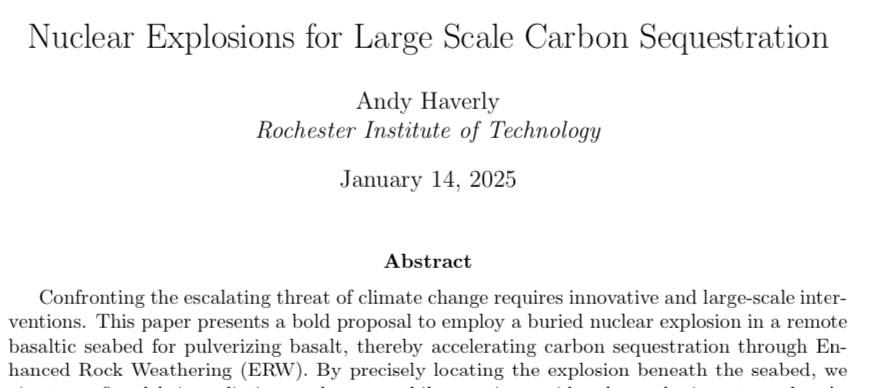
Paper is here: https://arxiv.org/pdf/2501.06623
I’m pulling for artificial diamonds. It’s the funniest solution: dumping truckloads of precious gemstones back down empty wells. Or burying them in the desert. Or I guess just handing them out for industrial uses, since even grinding them to dust isn’t the same problem as CO2. Have a free bucket of aquarium gravel, made out of worthless tacky gold.
Hey, if you can make diamond that easily, we can exchange a LOT of substances for it. Not just windows and glasses, but pretty much every ceramic object, insulators, but also just toilets (slap some paint on it and done).
Drop a plate, floor breaks.
Seems half-baked. Well unbaked really. They make a shit ton of assumptions that I’m not sure are true.
For example, why do they assume 90% pulverization efficiency of the basalt? Or is that a number they just pulled out of their ass?
And does ERW work if the pulverized rock is in a big pile on the sea floor? Or would we have to dig the highly radioactive area up and spread it around the surface?
And does the radioactive water truly stay at the site of the explosion? Or will it be spread through the entire ocean via currents?
Cool concept but, like, maybe we should check the assumptions a little harder?
This is “nuke the hurricane”-level science.
No, absolutely not. This is increasing the surface area and availability of rocks that take up CO2.
By “level”, I’m talking about the practicality and wisdom of the idea.
Gotta nuke somethin’.
deleted by creator
You mean the smash hit 2003 documentary The Core?
I feel like the podcast Behind The Bastards talked about this in the episode released today.
Did they talk about nuking the great lakes again?
No: this was about how the US Government considered underground nuking Alaska for the coal, killing cattle to check for cancer, and having people believe it was aliens. I was at work, so I may have missed a few points, but there was a discussion on power via turbine powered by nuclear weapon melted salt.
Re-naming all the Great Lakes to Lake America (with the easy to remember acronym “AAAAA!”) was one of the late night shows.