Write down more examples in the comments
Billionaires (or soon-to-be trillionaires) are creating a parallel government, replacing existing gov functions with privatized ones. We should start to do the same and start bypassing them with affinity groups.
Why not just kill police and stop paying taxes, while you’re at it?
This but unironically
We are not there yet
Why not just kill police
Because you can only get two or three, maybe half a dozen of them before they get really pissed and come at you with hundreds of guns blazing and fucking SWAT tanks and helicopters and shit.
and stop paying taxes
Already have, bruv. Already have.
Yes, but I always feel the need to add an asterisk to this so that people don’t go “…and that’s why voting doesn’t matter.”
The way that power works (in present-day democracies anyway) means that elected officials — even well-meaning ones — always end up serving the powerful, in at least some capacity (but very often nearly 100% of their policy-making).
But think about what that means. You’re not selecting your champion. You’re selecting your opponent’s champion. That still matters! A lot!
Voting won’t get us a fair and equitable world. But not voting can definitely make it harder to achieve.
No idea why people frame things as electoralism vs. direct action when you can just… do both?
Hmm…I don’t oppose the State because it is complex, I oppose it because it is unjust. I.e., I could imagine an anarchist community whose process is complex like the first directed graph, possibly more ‘complex’ (e.g. communities where consensus is the decision rule instead of majoritarian democracy; mathematically, the graph has more nodes and edges) but is still a liberatory system.
Mathematically, there’s no transition probabilities and no notion of time. The implication in the analysis that the first graph fails to capture is that in the situation described:
- The probability of success is vanishingly low, in particular because of the low transition probabilities of the two ‘Yes’ decisions.
- The transitions between nodes are all associated with long time delays, implying that it takes a very long time to traverse the graph, implying that the chance of success in reasonable time is very low.
Incidentally, the way you have constructed the graph, the probability that you will eventually succeed is actually one. So the argument from the graph implicitly relies on a finite time argument. In less formal terms, this is the liberals’ argument: (1) you get to success if you wait long enough, and (2) “long enough” is within human time scales. In my view, there needs to be a failure event with a transition probability, which models the fact that State systems rarely get stuff done.
Additionally, the direct action graph is missing a link: straight from the root to “Create a community kitchen…”, because it might be the case that the community already has the resources to start the kitchen. Really, I’m trying to highlight that “direct action” doesn’t necessarily mean “pool together money” or even any resources (even though it often does).
So I really really like where you’re going with this train of thought, but I’m a math nerd and proud pedantic fuckweasel, so I had to comment 🤓
The point I was trying to make was that direct action costs less energy, and is faster than electoralism.
I agree with both the points you’re trying to make…
pedantic fuckweasel shit
… but an unweighted directed graph doesn’t encode that information. An unweighted directed graph really encodes structure and direction. It can encode what transitions are possible, and it can be used to infer the sequences of events that can happen. However, unless you endow the graph with a weight function (how much space/time/energy/money/whatever it “costs” to “traverse” an edge), you can’t mathematically conclude that taking a sequence that loops a bunch of times before reaching the destination is better than taking a direct path just once, because you haven’t established a metric for what “better” means.
And the liberal argument would in fact be that even though direct action takes only one branch, it is a more “costly” branch than taking an average path through their graph, which consists of a series of low-“cost” steps. My argument from an anarchist perspective is that the liberal notion that the steps in the directed graph of the liberal political system are “low-cost” — in terms of time, energy, or money — is privileged nonsense. But unfortunately, seeing merely the unlabeled graph doesn’t bring this to light.
So an informal way to do this might be to mark the branches with text that indicates the character of the branch. Or if you don’t mark it, then this would be the character of the arguments liberals will use to misread your approach (because they always will misread your argument).
Edit: more pedantic fuckweasel shit
Here’s a counterexample that demonstrates my point:
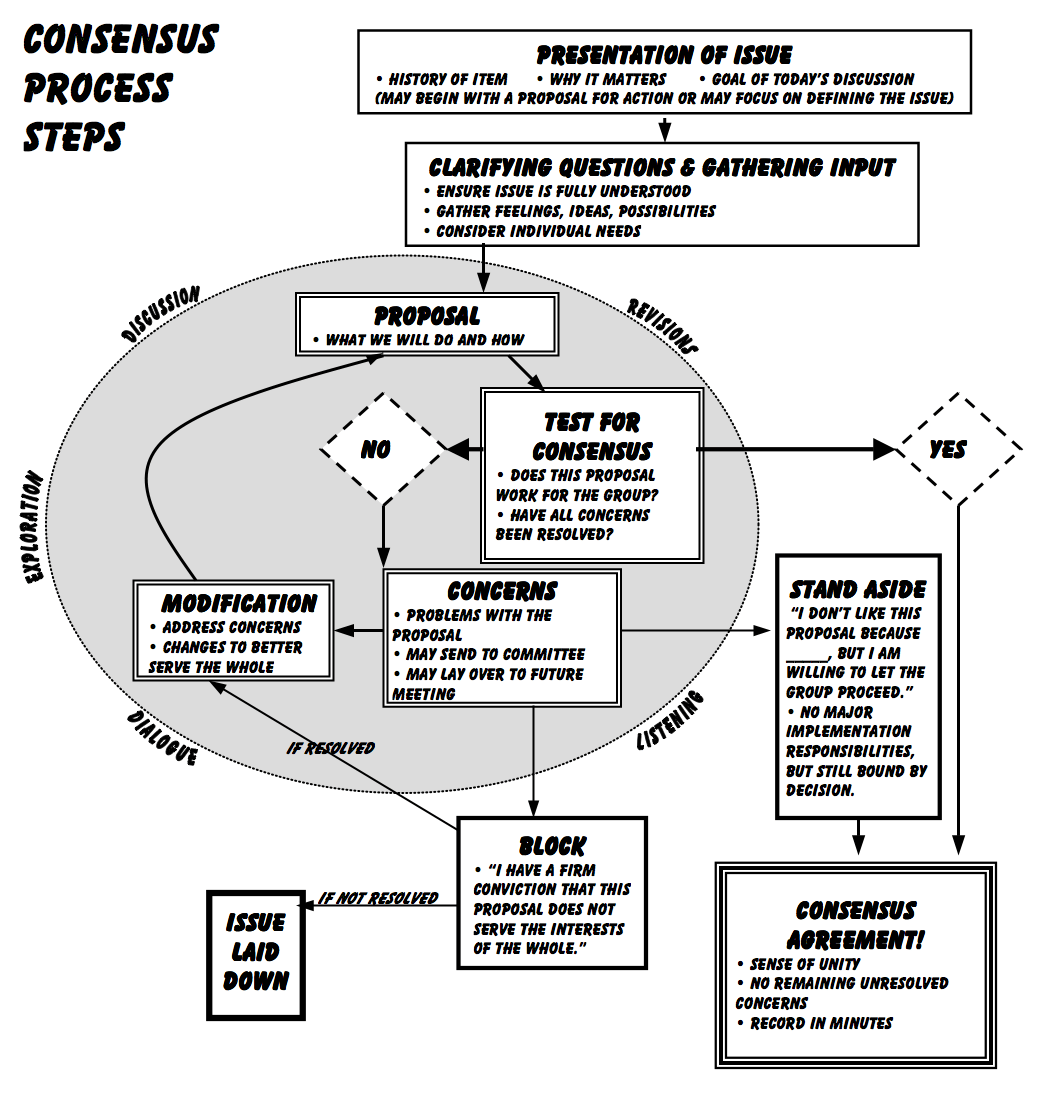
I got this from Neighborhood Anarchist Collective’s Facilitation Guide. Just like your graph, there is are loops which can be traversed an unbounded number of times (i.e., there is nothing stopping you from going around the loop zero times, once, ten times, a billion times, etc.). In my view, this is a workable specification for consensus-based anarchist decision making. It is excellent reading for any anarchist.
Now taken in isolation, their raw directed graph has the same issue as the one your directed graph would be used to argue is a bad system. But NAC’s diagram is a summary of an article which, in my view, makes it clear in prose that the time and energy spent traversing each branch is vastly lower than the cost of electoralism. Additionally, they even surrounded some of the branches with that nice circle, which suggests that these items have similar weights. So with that context, their argument pushes through.
It also reveals that another way to encode cost is to give the nodes (not necessarily the edges) a weight. This is what NAC does informally by putting prose inside some of the nodes.
In contrast, your directed graph might benefit from a bit more information, unless you intend to include it as part of prose explaining why, in your context, simplicity of the graph maps to better outcomes.
Sorry about being such a pedantic fuckweasel here, but my research uses directed graph theory. One thing I’ve learned is that your modelling representation is super important when doing stuff with graph and digraph objects, because it can either vastly simplify or complicate the solution to your problem. So I kinda have to be pedantic 🤓
Idk much about graph making 😔
There’s also ballot initiatives for bypassing your reps and enacting laws based on the will of the people.
Only sometimes effective.
Somebody still has to enact and enforce those laws, and the local government often does that deliberately badly … or not at all. They often find some crooked legal way to block it.
As is the direct action approach. It could run afoul of school access laws, food safety regulations, or exclusivity contracts for suppliers of current (paid) school lunches.
And a group of concerned parents vs Aramark getting their paycheck? Aramark is gonna win.
You could change that electorally through ballot measures, or competent reps on the school board, local legislatures, and judicial positions. Or you could change it through violently replacing the whole system, but just walking into a cafeteria with free food will get shut down relatively quickly.
You could do it for breakfasts and dinners though since that doesn’t require cooperation with the school.