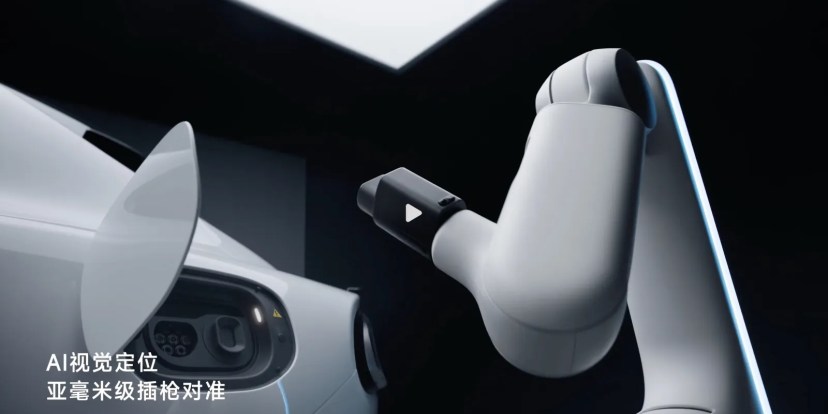
Xiaomi plans to launch a compact home charging robotic arm by late 2026, delivering the hands-free, high-efficiency plug-in experience for electric cars that Tesla famously abandoned a decade ago.
Robot arms are expensive and mostly applicable in scenarios with consistent positional repeatability, while people parking cars certainly lacks that repeatability.
Why do we need a robot arm to charge EVs? It feels like a solution looking for a problem. It’s not like manually connecting the fuel source to a vehicle is something unique to EVs, drivers have to connect the hose to their ICE vehicle at the gas pump too, and it works pretty well.
I could maybe see an argument for accessibility here, but, again, solutions that work for ICE vehicles would apply here too.
There is potentially an application for something like this with a self-driving fleet for unattended recharging stations, but this is being marketed as a home-charging tool.


Robot arms are expensive and mostly applicable in scenarios with consistent positional repeatability, while people parking cars certainly lacks that repeatability.
Why do we need a robot arm to charge EVs? It feels like a solution looking for a problem. It’s not like manually connecting the fuel source to a vehicle is something unique to EVs, drivers have to connect the hose to their ICE vehicle at the gas pump too, and it works pretty well.
I could maybe see an argument for accessibility here, but, again, solutions that work for ICE vehicles would apply here too.
There is potentially an application for something like this with a self-driving fleet for unattended recharging stations, but this is being marketed as a home-charging tool.