
AmbitiousProcess (they/them)

  • 1 Post
  • 17 Comments
Joined 1 year ago
cake
Cake day: June 6th, 2025

help-circle

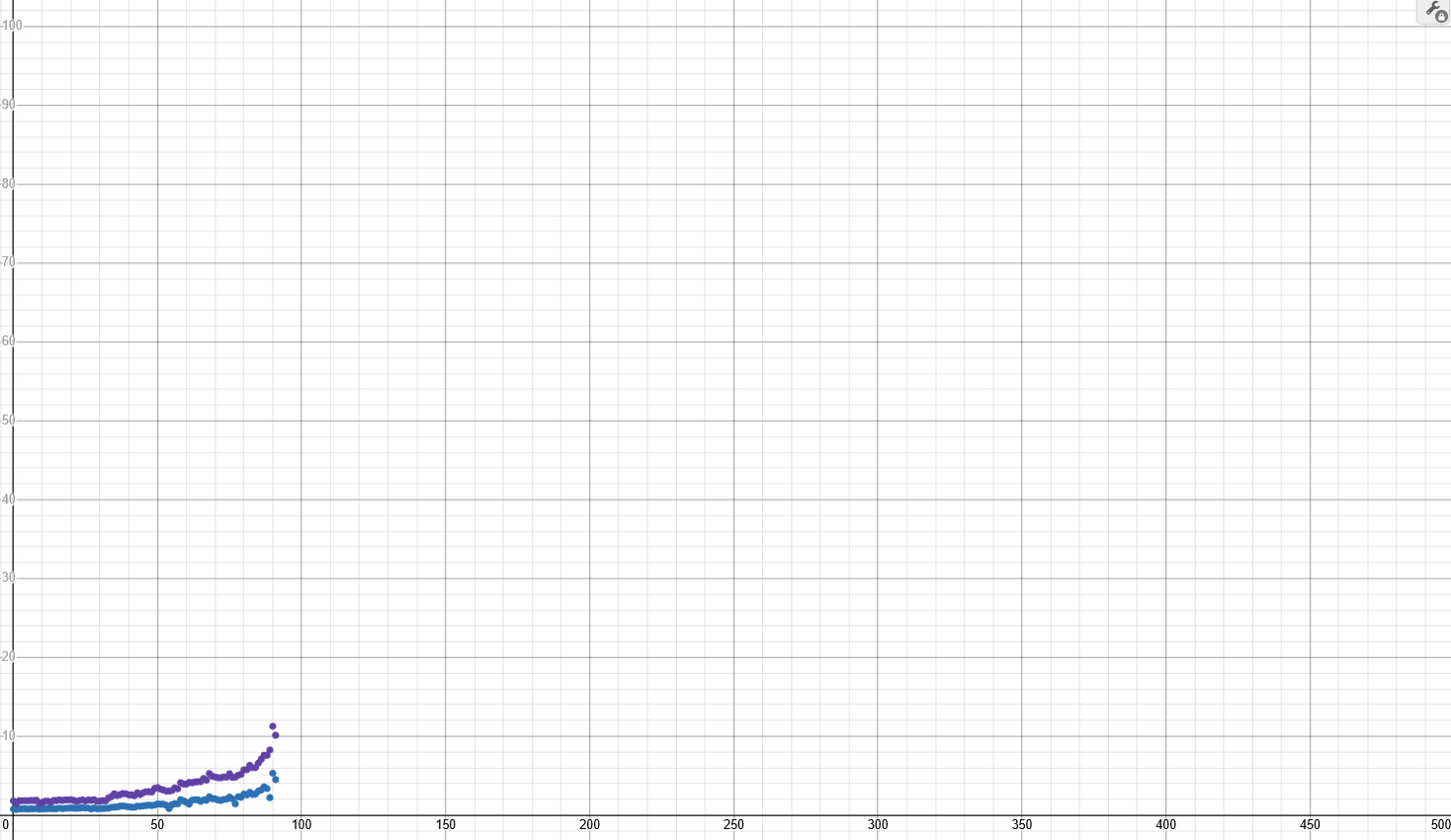
  • the usa gov graph shows a daily stat.

    The frequency of a stat doesn’t guarantee long-term assumptions. I could track linux market share every millisecond for a week, but that wouldn’t make it much more of a reliable stat than counting it daily for that week instead. The problem isn’t the frequency of the data, it’s the timeline, and the scale.

    Linux has so few users relative to the other players in the market, and the data being collected is for such a relatively short timespan where any meaningful changes to the numbers are happening, that it can’t give you a good picture.

    For example, if I start a club, and I gain an average of 10% more members every day for the first week, is it safe to assume nearly all of the people in the world will join my club because I currently have an exponential trend in my member count? Obviously not. I’m probably just pulling in people from my local community, and eventually I’ll have gotten most of the people in my area that are actually interested in joining. I have an exponential trend for now, but it’ll flatline in the next few weeks.

    if u have any other websites that show linux stats lmk

    I don’t, but the sources cited here are actually the ones I personally have already relied on for a bit now. They’re fairly accurate in their own ways. It’s reliable data, just not necessarily indicative of future trends.

    there are also reasonings listed in the dropdown at the top of the article

    They’re good reasons, but they still don’t do anything to actually validate the assumptions made in the graph. The reasoning is “Linux will probably grow because of x, y, and z… therefore this exact mathematical function is probably accurate”

    They help support the theory that Linux marketshare will grow, which I personally do believe to be true, but they do nothing to actually guarantee any numbers. They could mean a 0.1% gain in marketshare per year, a 1% compounding gain, a temporary dip because of any unforseen world events that isn’t accounted for by that function, etc.

    To bring it back to my previous analogy, it would be like if I said “all the people joining seem really invested in [club topic], are telling all their friends about it, and membership growth has been very steady, with more people joining over time through referrals from friends. This means I’ll probably see exponential growth”

    “This exact mathematical function proves I’ll have most people in the world in my club in 10 years”

    Hopefully that all makes sense? Genuinely not trying to be confrontational at all, I just want to make sure you don’t get your hopes up because the graph looks like it’ll be guaranteed and then be disappointed if it’s not 😅








  • Yeah, it’s a social construct in the sense that it’s just natural differences among humans, specifically differences that don’t as often square with societal/social norms as the average person. If society were comprised of all autistic people, you wouldn’t have the label “autism”, you’d just have “people that are the way people are.”

    That said, unlike the article implies, autism is, of course, not just something everyone is choosing, making up, or using to justify not doing work.

    I will note the article doesn’t technically say “everyone with autism is faking it and it’s not real”, it just implies that because a lot of people self-diagnose with it now, that must mean that the real numbers are way lower than they actually are, and that people who have autism, but don’t experience major social or productivity related issues from it, aren’t actually autistic and are just “introverted” or some other general term that could theoretically apply.


  • I managed to get past the paywall on the article somehow, so here’s the actually important stuff:

    But for a community organized around social impairment, they maintained an astonishing number of social rules. Certain language and beliefs were treated as harmful, and activists policed them aggressively. Terms like high-functioning, low-functioning, severe, and profound were condemned as “ableist.” Again and again, I watched popular accounts direct their thousands of followers to comment sections so they could scold people for using the wrong language or expressing the wrong views about autism.

    AKA “muh free speech”

    Activists reserved particular contempt for anyone who upheld the medical understanding of autism spectrum disorder, targeting organizations, researchers, and universities that treated autism as a disorder and supported work on its causes, treatment, or cure. They compared that work to eugenics and tried to shut it down through petitions, harassment, and public pressure. Too often, they succeeded.

    “We should ‘fix’ autistic people, why doesn’t everyone agree with me??? 😢”

    when I began referring to myself with the term Asperger,

    The response was fierce. Activists rejected the idea that there was any sort of hierarchy in the autism spectrum.

    “Why don’t people like it when I use an outdated term, removed from the DSM-5, that is often used to imply low intelligence of autistic people and want me to use the more broadly accepted inclusive term instead???”

    Then, my life changed. In 2022, after working for several years as an artist, I became a journalist. The career shift was spurred by my discovering the stories of detransitioners: mainly young women who had once identified as transgender and now no longer did, and whose experiences were largely ignored by mainstream media. I could relate to them; many of them, like me, had struggled deeply as teenagers and searched for a label that seemed to explain their suffering. As I learned more about their experiences, I was forced to think more critically about how activism and media shape cultural narratives around identity and diagnosis, and how perverse social incentives can lock those narratives into place.

    “I saw people detransition and that means that means autism can be a social contagion and because I see it as debilitating I want a reason to believe I’m faking it”

    I soon began taking on stories that required heavy reporting. As I spoke with sources, built rapport, asked sensitive questions, and earned their trust, I realized something that should have been obvious much earlier: I do not have a social communication deficit. Not only was I competent at socializing, I was good at it, and I improved the more I did it.

    “I’m good at socializing therefore I don’t have autism”

    Which forced me to ask: What else could have explained my social discomfort? In retrospect, the answer was more ordinary than I wanted it to be. I was a sensitive, introverted child who felt social mistakes intensely. Instead of responding to them by becoming more resilient, I chose to retreat into my interests, because they felt safer than people. Over time, that withdrawal hardened into a pattern.

    “Pull yourself up by your bootstraps” but applied to emotions. If she’d just responded better to mistakes, she’d never have been diagnosted as autistic, guys!

    My diagnosis unraveled further once I started questioning the other traits I had come to see as autistic. Introversion, high sensory sensitivity, intense interests, and social camouflaging are not exclusively the features of an autist; they are widely distributed across the general population. But using the female autism framework, I came to see them as a meaningful pattern.

    “I have a ton of heavily correlated traits that are all often linked to autism, but if I look at them individually instead of recognizing the actual pattern, and say that non autistic people can have them too, that means I’m ‘normal!’”

    This happened very swiftly, partially because an autism diagnosis is not especially difficult to obtain. The process, which has no objective medical test and relies primarily on self-reported traits interpreted by individual clinicians, leaves enormous room for confirmation bias and error. My own evaluation did not consider alternative explanations for my experiences, only that they had been present since childhood.

    “We can’t do a DNA test for autism, therefore doctors must be just guessing and patients must be making it up”

    Research shows that more and more people, especially young women, are over-identifying with psychiatric diagnoses, desperate for some sort of label to explain their struggles or abnormalities.

    “More people are self-diagnosing, therefore trained medical professionals using actual diagnostic methods will also be diagnosing a ton of people with autism that don’t have it”

    Losing the autism label allowed me to regain something more valuable than certainty: agency. My difficulties did not disappear, but they no longer defined the limits of who I could become. There is comfort in a story that shifts responsibility away from the self. Sometimes that comfort is almost irresistible. But in the end, it is better to believe in the possibility of change than to embrace a narrative that says you never had a choice at all.

    “If you think you’re autistic, you’ll assume you have innate limits and stop trying hard enough.” AKA “Autism stops you from reaching your full potential and is a crutch”


  • Better portrayal of Mozilla’s response from this ars technica article:

    The vulnerabilities identified by Mythos could have also been discovered either by automated “fuzzing” techniques or by having an “elite security researcher” reason their way through the browser’s complex source code, Holley writes. But using Mythos eliminated the need to “concentrate many months of costly human effort to find a single bug” in many cases, Holley added.

    The key part there is fuzzing. These tools have existed for a while. (and many are free!!!) Mythos just does what most AI tools do: Take something that requires more understanding or effort, and condense it into a prompt. Instead of starting a fuzzing tool, configuring its scope and some parameters, then letting it go hog wild for a bit, you just tell the AI model with a prompt to perform similar functions. (while costing more money and taking more time due to inevitable overhead from running a whole LLM)

    If anything, this points more towards Mozilla not using existing fuzzing tools to find flaws in their code because they were too lazy, not that Mythos is magic and superior to all else.


  • Most can, but they still rely on your phone getting an internet connection later, on your phone being trusted to send data over itself, and of course still require your phone to actually be charged. (Can change if it’s a regular card depending on the issuer though)

    Also, if you’re just generally curious about stuff related to offline payments, there’s actually a major security hole that Visa refuses to fix, which allows a device to pretend to be an offline-only card reader, then charge any value to someone’s card, and get away with it, even if their device is locked.

    Not really a point in favor of my original argument though, since CBDC infrastructure would require replacing or updating all the readers anyways, and implementing the standards to prevent such an attack, like MasterCard has used for a while now.


  • In 2026, when is your phone running out of battery

    Not too regularly to me, but it happens frequently to most of my friends, and some street performers I know who don’t always have good access to a power outlet, or the money for a portable charger.

    …or losing wifi?

    I and many other people regularly experience complete cell dropouts when at my local grocery store. No service. (Works fine outside and slightly down the block) We are in a city, not the middle of nowhere either.

    There have also been internet dropouts for my local store’s machines, meaning people paying with cash could go instantly, whereas people who only had cards or phone payments had to wait in a massive line since every transaction took 2 minutes to go through.

    You can also just get a crypto card if your worried about your phone being unreliable.

    Sure, but at that point I could just get literally any card. I was only commenting on CBDCs, though I suppose the same critiques could apply to direct crypto transfers.

    At the end of the day, CBDCs tend to rely on phones to work, and thus can’t work if your phone doesn’t, unlike cards, and especially unlike cash. (given cash relies on nothing but you and the person you’re transacting with believing the cash is real, vs phone payments or even just cards still requiring an internet connection at some point, and power to the reader, plus permission from an external gatekeeper as the cherry on top)