
- 10 Posts
- 8 Comments

Because the important factor is being in the European Broadcasting Area. This area is bigger than the European sub-continent and includes all countries with Mediterranean coastline and some countries to the east of Israel. Wikipedia has this helpful map:
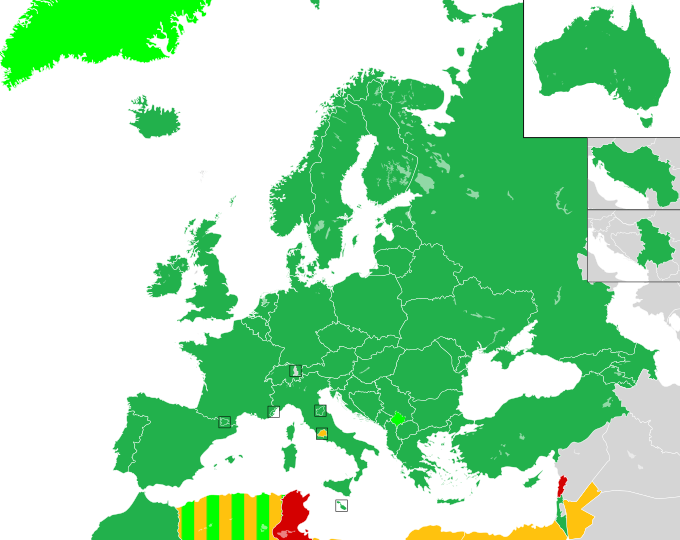
dark green: Countries which have participated in the Contest at least once.
yellow: Countries which are eligible to participate, but have not (yet) done so.
light green: Countries which have competed in the contest as a part of another country, but never as a sovereignty.
red: Countries which were supposed to compete in the contest but withdrew right before the final.
https://commons.wikimedia.org/wiki/File:EurovisionParticipants.svg
As you can see Marokko competed one time, Tunesia and Lebanon had had at one time real plans to compete and Jordan and Irak are also eligible but opt to not participate.
Australia on the other hand isn’t eligible at all but requires a special invitation from the EBU which they have received every year for the last ten years and are likely to receive until the contest collapses.




 4·10 days ago
OK, so CryEngine and it’s open source descendant O3DE already exists
Two of the three parties have set up their own Mastodon instances years ago (grüne.social and social.linksfraktion.de respectively).
The Left is also present at @[email protected]
And even high ranking SPD politicians are active on the Fediverse (@[email protected] for example)
They are going to be present on closed platforms, because like it or not (and for the record I don’t) that’s where a large part of voters is, but the Fediverse plays an active part in their social media strategies.
Orion isn’t Chromium based. It’s based on WebKit. Chromium uses a WebKit-fork called Blink, that’s diverged quite a bit from its origins

What do you mean “planned successor”?

Sure, technically it’s a replacement for a bunch of services. But from a institutional perspective you wouldn’t use Signal in the first place, just like you wouldn’t use WhatsApp. You want closed (as in no open participation not as closed source) systems where only employees can send messages in the first place. Traditionally you would use Slack or MS Teams for that.
That doesn’t mean that your employees wouldn’t use WhatsApp or Signal anyway and having a convenient alternative might curb that use.
- A lot of the solutions are based on standards that already include E2E. The French and German platforms for example are just rebranded Matrix.
- the platforms are not intended for civilian communication. The video is a bit misleading when it talks about WhatsApp alternatives. A more accurate description would be “Slack alternative”: A communications platform for government workers to message each other, so that potentially sensitive data isn’t stored on 3rd party servers.







In the original German it’s “schönste” which directly translates to “prettiest”