There’s no “constant 4th dimensional vector” here.
You’re overcomplicating it by treating the 4th dimension as time. In a tesseract puzzle, the 4th dimension is just another spatial direction. The ant simply walks across adjacent cubic cells on the hypersurface, much like walking across faces of an ordinary cube. The problem reduces to finding a path through the adjacency graph of the 8 cells.
And despite your confidence, your answer is wrong. You’re talking about a 3-cube embedded in 4-space instead of a 4-cube, which is why you only see 6 faces, whereas a 4-cube (a tesseract) has 24 faces.


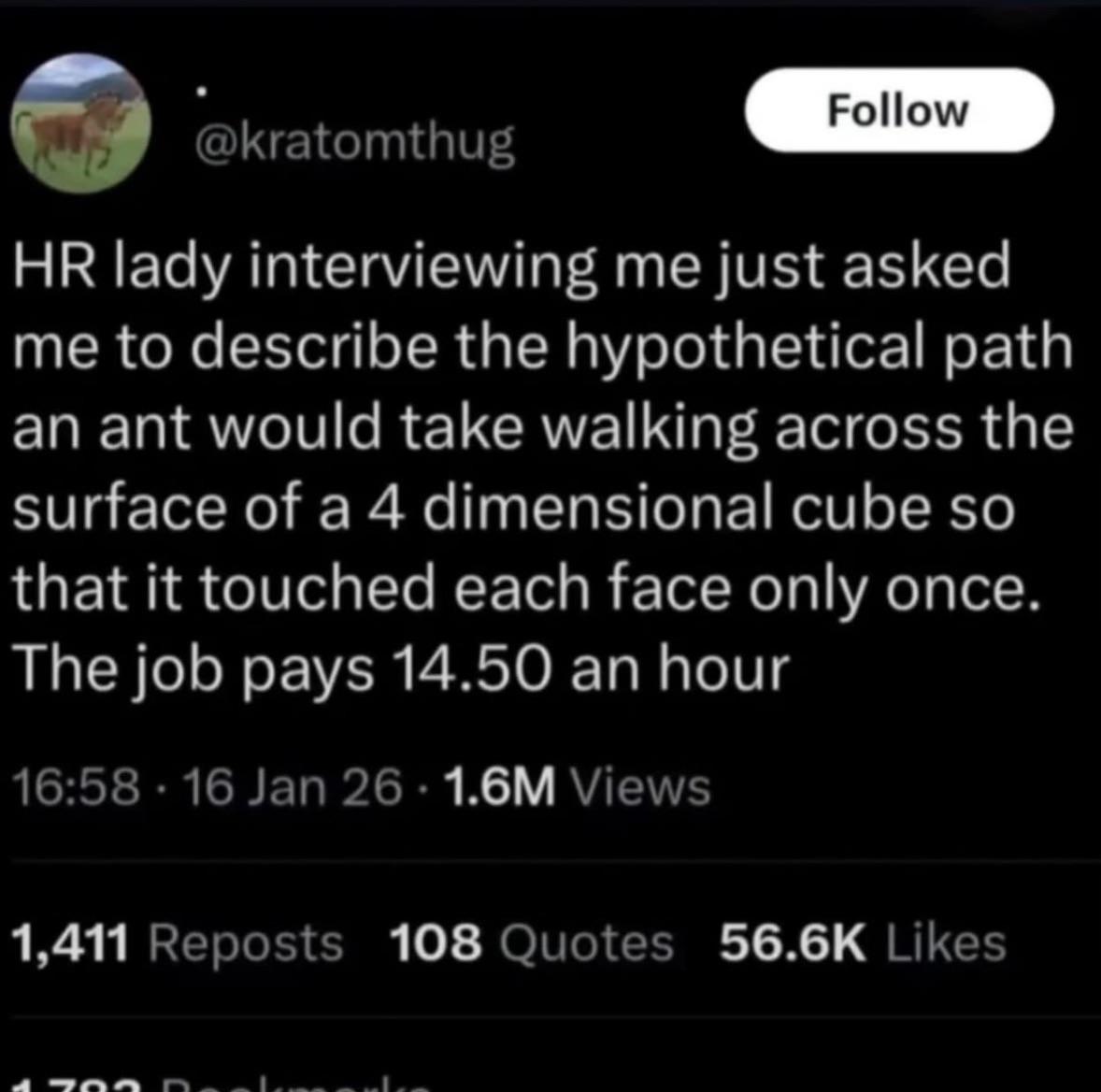
There’s no “constant 4th dimensional vector” here.
You’re overcomplicating it by treating the 4th dimension as time. In a tesseract puzzle, the 4th dimension is just another spatial direction. The ant simply walks across adjacent cubic cells on the hypersurface, much like walking across faces of an ordinary cube. The problem reduces to finding a path through the adjacency graph of the 8 cells.
Your lack of understanding of movement as a combination of vectors makes me think you’re talking out your ass.
This is linear algebra. The solution can be written as a matrix of 4th dimensional space. Its all vectors.
And despite your confidence, your answer is wrong. You’re talking about a 3-cube embedded in 4-space instead of a 4-cube, which is why you only see 6 faces, whereas a 4-cube (a tesseract) has 24 faces.
Real life cubes are 4 dimensional.
The 4th dimension is time.
How you define the 4th dimension changes the question and I leveraged that to get an easy solution.