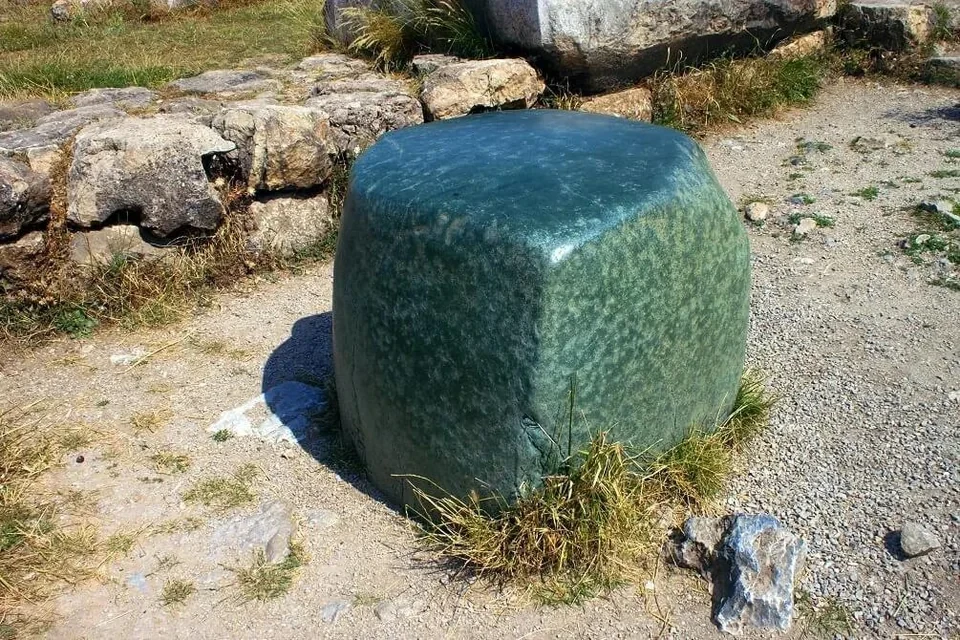
The Hattusa Green Stone is a roughly cubic block of what is believed to be nephrite standing in the remains of the Great Temple at Hattusa, capital of the Hittites in the late Bronze Age. Now on the hill above Boğazkale, in the Turkish Province of Çorum, Hattusa is a World Heritage Site.
The original purpose is unknown, but serves as a tourist attraction today.
The stone measures 69cm (27in) per side, and weighs about 1,000 kilograms (2,200lb). It is supposed by some to have had a religious use or purpose, but what that may have been is unknown. The suggestion has been made that it may have been merely the base of a statue, however the stone is the only one of its kind found at Hattusa. --WP, with some JE edits
So, not quite the Voynich Manuscript, but an interesting object nonetheless. And quite a bit heavier(!)
In the Lebanese city of Tyre, I visited the ancient ruins & saw an identical stone --u/Msqueefmaker
The liter, kilo, meter all come from the metric system, which didn’t exist in the time of the Hittites. It’s not about underestimating them, they had other units of measurement, but that obviously wasn’t metric.
The Egyptian “Elle” was 50 cm, so 1/2 a meter. So they could have measured 125 Liter using 1x1x1 “Elle”.
I dont know the density of the material, that would be interesting to know. The cube looks like it was important to them. Maybe it was to measure big shipments of wares. Since they probably used scales back in that time.
Long story short: Seems like quite the coincidence, even more so if you consider the work that had to be put into carving the stone.
But well, maybe it was a doorstopper?