
- cross-posted to:
- [email protected]
- cross-posted to:
- [email protected]
You must log in or # to comment.
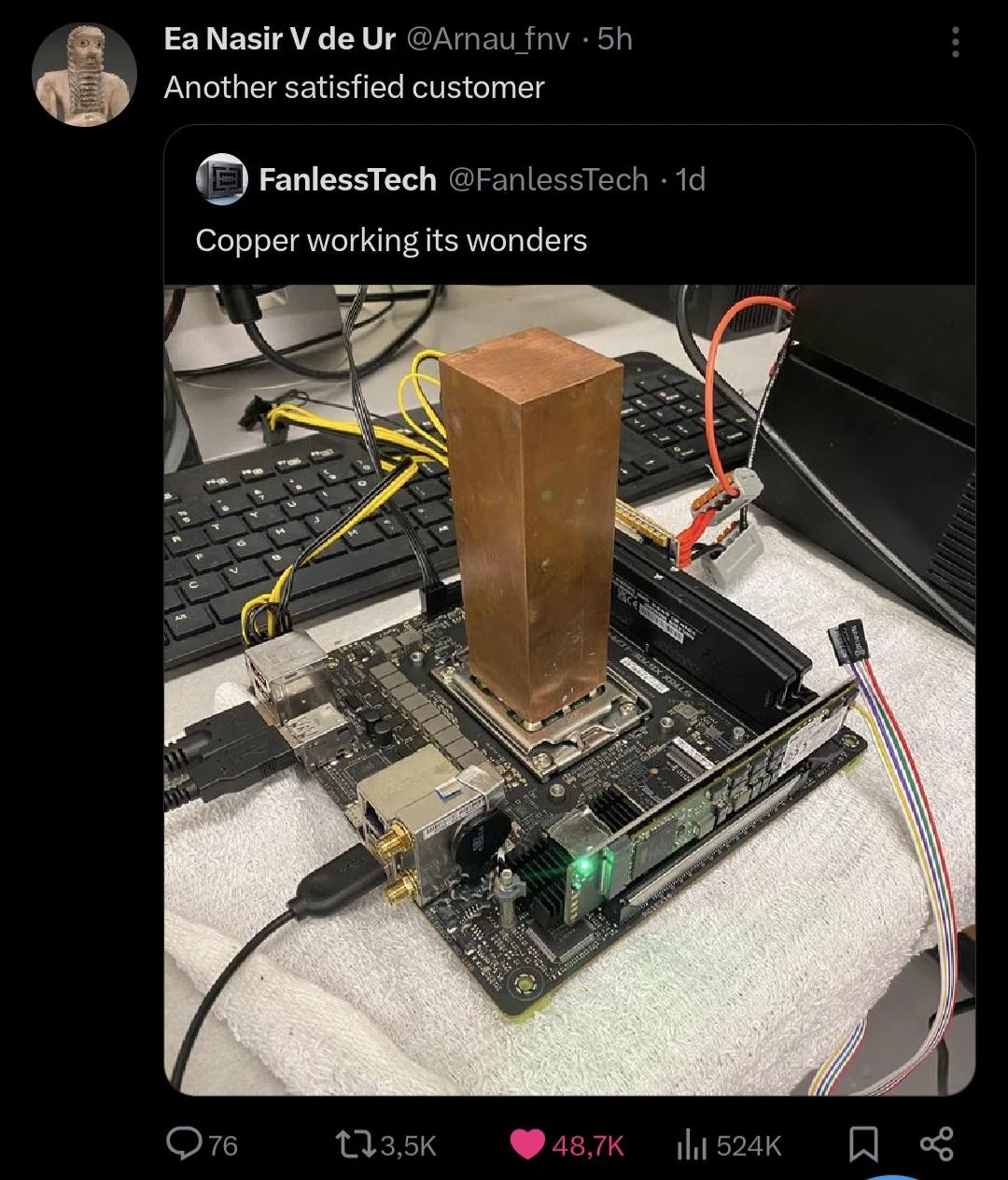
Copper is actually ~25-250X leas efficient at transferring heat than a heat pipe and convection is hundreds of times more efficient than radiation at transferring heat and the fins on a heat sink would have hundreds of times more surface area for dissipating heat all that is to say this might work but it would be orders of magnitude less efficient than a standard heat sink.
Heat pipes are fucking magic and you can’t convince me otherwise
PHASE CHANGE IS LIFE
Looks nice. Why they don’t sell PCs with cooling like that? What are the downsides?
I would guess that the low surface area would lead to problems. At first it would cool very well because of the huge thermal mass, but once it reaches thermal equilibrium the cooling would be quite weak.
So we need more copper?
Yes! The only way to increase the surface is to build a higher tower!
I’d also think moving your PC will rip your CPU right off the motherboard
The trick is not to move the PC, but rather the copper block, which just happens to have a PC attached to it.
So, you’re saying that putting blocks of copper on everything in a PC will automatically shed unnecessary parts, building a more efficient system?
Just run a solid copper block for maximum efficiency.
Wouldn’t gold be more efficient? Can’t I just fill my PC with gold doubloons? The rattling noise means it’s running.
how long till it reaches thermal equilibrium? maybe it can endure a full load for an hour
Your mom can endure a full… oh never mind.
You’re looking at about a half hour per kilogram of copper to raise it by 50 °C with 100W of heat.
Actual delta from ambient to thermal limit will typically be a little higher than that, but so is processor wattage on mid-to-high performance CPUs, so I’m happy enough with that as a ballpark estimate.
Someone else estimated that block as 4.5kg, so you’ve got something close to two and a half hours of cooling from an ambient start.
lead to problems
We’re talking about copper, dumdum.
I have a micro ATX case that itself is the cooler. Heatpipes transport the heat to the case walls and they have fins to increase surface area. It can handle up to 65 watt CPUs.
It’s not produced anymore. But with all the talk of the Gabecube I’ve been itching to make a new build with it. Unfortunately I have neither the money or the energy.
Do you have any idea how expensive a solid block of copper that big is?
If that block is roughly 4.5cm x 4.5cm x 25cm then the volume of it is about 500cm³ which translates to 4.5kg of copper. At 11€/kg that makes about 50 euros.
Cheaper than some noctua coolers.
Yes but you save on manufacturing.
Would you even notice, after buying the ram and storage?
What’s a solid block of copper cost? one banana?

Despite the cost, it’s damn heavy.
Despite the size i would be very surprised if this was even equivalent to a moderate performing air cooler. The reason normal coolers have all the fins is for more surface area and youre able to easily and effectively push lots of air through, pullung heat off those surfaces.
Copper is actually ~25-250X leas efficient at transferring heat than a heat pipe and convection is hundreds of times more efficient than radiation at transferring heat and the fins on a heat sink would have hundreds of times more surface area for dissipating heat all that is to say this might work but it would be orders of magnitude less efficient than a standard heat sink.
Why copper? Aluminum works way better as a dissipation surface.
Copper has more mass, heat capacity, and thermal conductivity per litre.
Is aluminium actually more effective as a dissipation surface? I hadn’t heard that.
Copper is better conductor but it’s worse at dissipation. Do the experience yourself, heat a block of each and then touch them afterwards.
Is that not because the copper holds more heat, so stays hot for longer at the same dissipation?
Maybe you’re right, but I remember than in the 2000s I’ve had identical cpu heatsinks in both copper/aluminum versions, and the aluminum one had better performance. And then they started to make hybrid ones, stating that the copper part was to allow rapid heat transference and the aluminum parts to improve dissipation. But maybe it was all marketing.
deleted by creator
Why is the motherboard resting on a towel??
When I work on stuff with tiny parts, it helps to do it on a towel. If you drop something, it tends not to bounce too far, things don’t roll as much, etc., and it’s easy to see stuff on a white towel.
They don’t want to scratch up their desk with the solder joints on the back of it? I’d normally use cardboard, but a towel probably works too 🤷
Or maybe it just has muddy paws that need toweling off 😜