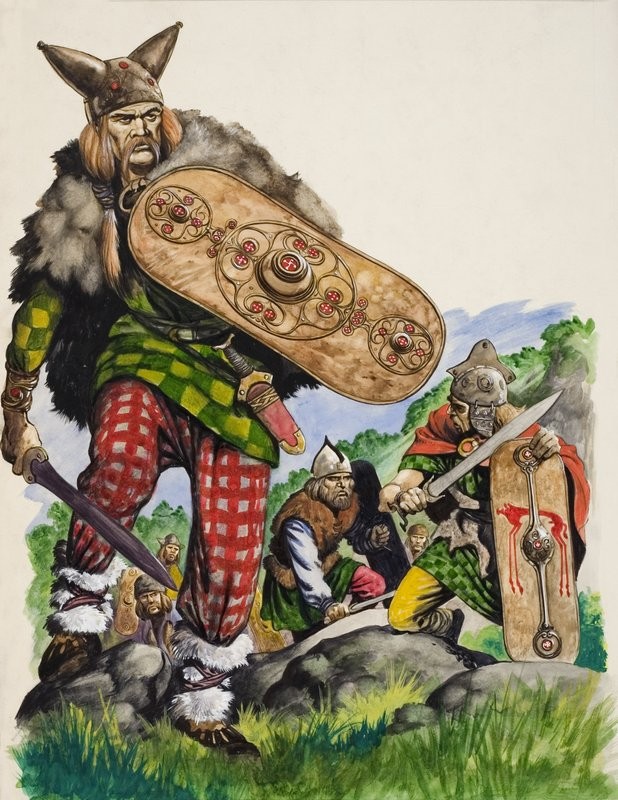
Most of the historical helmet projections were fanciful additions by later artists, were they not?
Otherwise they could be a terrible liability for hand-to-hand fighters, I’m thinking.
There’s actually significant evidence for Celtic helmets with ornate protrusions! It’s suspected that such helmets were either ceremonial or otherwise for high-ranking individuals, rather than made for practicality, though.
Makes perfect sense!
And… just found this interesting page, below, in which the lead warrior’s helmet is depicted in the middle-page illustration. (cool collection, but terrible text formatting, perhaps based on translation issues)
https://x-legio.com/en/wiki/celtic-helmet
An absolutely amazing example of a horned ceremonial helmet was found in the Thames near Waterloo Bridge (18).
So evidently, Mssr. Jackson just kind of inserted some interesting helmets in to this ‘prowling troops’ depiction, disregarding the fact that these troopers would likely be wearing more practical helmets that we can see in the first three page photos.
over time, the Romans adopted them for armament, somewhat modifying them to suit their needs and traditions.
I found that interesting, too.
over time, the Romans adopted them for armament, somewhat modifying them to suit their needs and traditions.
I found that interesting, too.
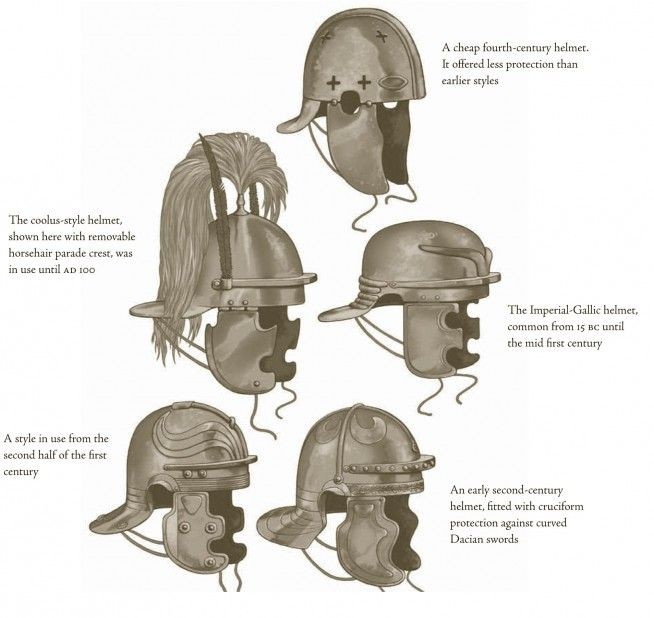
The most famous and iconic forms of Roman helmets, even, are Celtic in origin! Even earlier Republican-era helmets are Celtic designs.
Romans had no shame about taking what worked from other cultures, lmao.
There’s a famous Picasso quote that goes “good artists copy; great artists steal” that seems to fit pretty well. (altho, uh, actually it seems to be an invented quote)
Anyway, thanks for illustrating! Most of my visual references of Roman and Celt’ battle gear goes to the Astérix books, so this was slow-dawning on me, but a lot clearer given all the various links and pics.
Regarding the very last helmet depicted-- it seems that the threat of the mighty Dacian Falx sword necessitated reinforcing the top of the Roman helmet, lest it be split right open(!) From what I’m understanding, those curved swords could cleverly reach around the shield to bust open yon olde coconut.
“Look at all those beauties!” --Steve Irwin (RIP)
https://www.google.com/search?q=dacian+falx+swords&udm=2Not only reach around the shield, but they were also often wielded with two hands, with a curved blade, and pretty hefty weapons at that. So without the ridge and the reinforcement, the falx could puncture a (small) hole through the helmet itself, or else ‘slide’ down the curvature of the helmet and end up in some poor legionaries face.
Gol’daggit, if only I knew more about history, this might make for a fun little show…
“A fool, and his lightweight-wisdom, quizzing an actual scholar of history upon this or that.”
LOL…