
You must log in or # to comment.
https://en.wikipedia.org/wiki/John_C._Woods
Before D-Day, U.S. military executions by hanging in the European Theater of Operations occurred in Southern England only and were performed by the civilian executioner Thomas Pierrepoint, with assistance by Albert Pierrepoint (his nephew) and other British personnel. When in autumn of 1944 military executions by hanging were scheduled in France, the Army looked for a volunteer enlisted hangman and found Woods, who falsely claimed previous experience as assistant hangman in two cases in Texas and two in Oklahoma. He later told newspaper reporters that his career as an executioner had started when he “attended a hanging as a witness, and the hangman asked me if I wouldn’t mind helping.”[3] There is no evidence that the U.S. Army made any attempt to verify Woods’s claims—if they had checked, it would have been easy to prove that he was lying; the states of Texas and Oklahoma had both switched to electrocution during the period he claimed to be a hangman. The last hanging in Texas took place in August 1923 when Woods would have been twelve. Oklahoma did not carry out hangings during the relevant period, the last one taking place three months before Woods was born. There was a single hanging in 1936 under federal jurisdiction, while all other executions in Oklahoma between 1915 and 1966 were carried out by electric chair.
Woods also participated in the execution of about 45 war criminals at various locations which included Rheinbach, Bruchsal, Landsberg, and Nuremberg. Donald E. Wilkes Jr., a professor of law at the University of Georgia Law School, wrote that many of the Nazis executed at Nuremberg fell from the gallows with a drop insufficient to snap their necks, resulting in their death by strangulation, which in some cases lasted up to 15 minutes.[1]
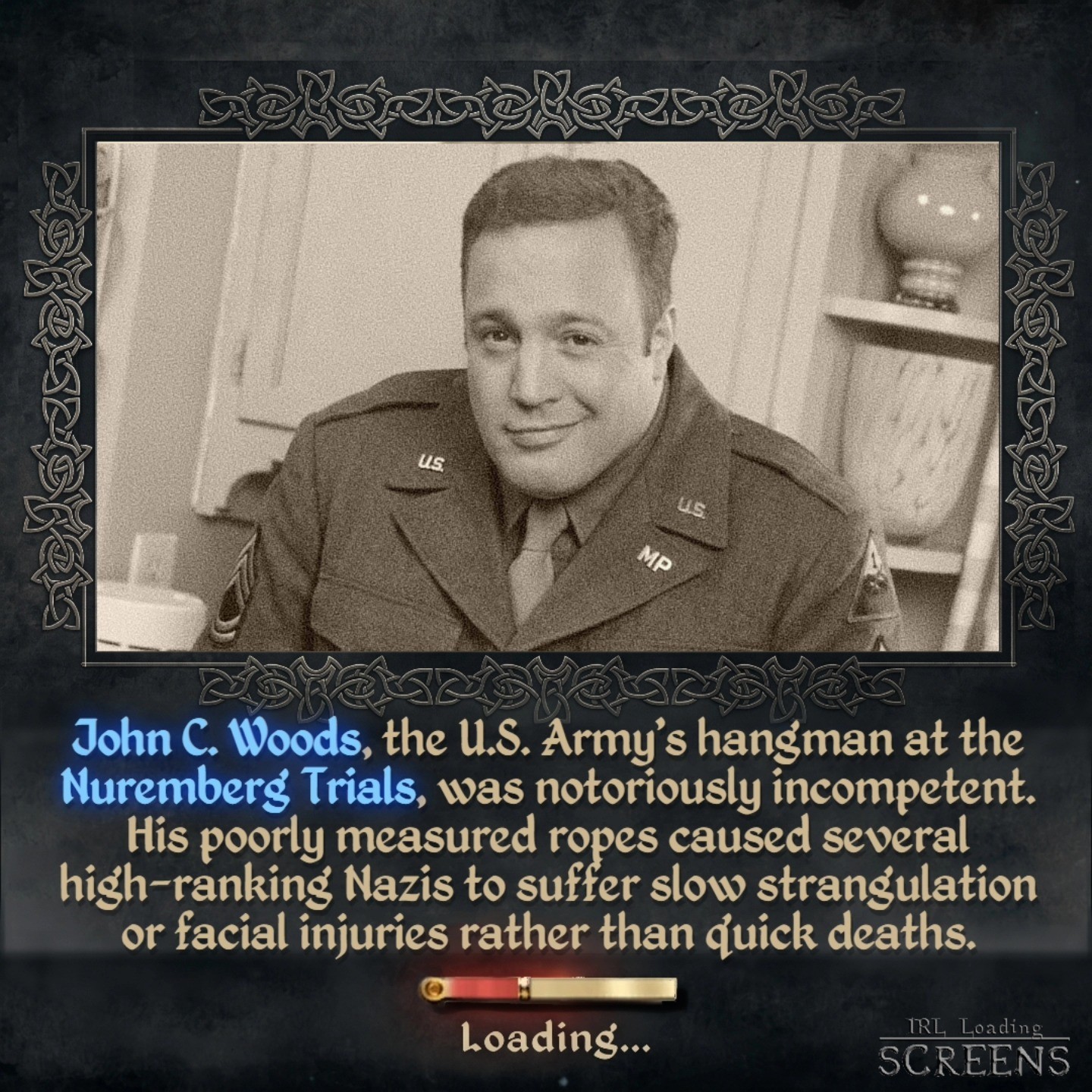
honestly the image of him in the article is funnier. he looks like he barely knows where he is.
Judging by the last part of the article, he really might not have.
On July 21, 1950, Woods was accidentally electrocuted when he tried to change a light bulb while standing in a pool of water. He was buried in Toronto Township Cemetery, Toronto, Kansas.
What a droll way to say he killed himself.
Not being sober ever again might help with that job
Giving me Kevin from the Office vibes lol.
He looks like David Mitchell (The are we the baddies guy)
On July 21, 1950, Woods was accidentally electrocuted when he tried to change a light bulb while standing in a pool of water.
Now there’s an “oopsie”!
Ah so he fell out of a Wile-e-coyote cartoon
The OG Wichita Lineman, huh?
That was about a phone technician.
Catling claimed that they were not properly tied, so that some hit the platform with their heads as they went down and their noses were torn off." Although the “U.S. Army denied his story”, photographs of some of the deceased, such as Wilhelm Frick and Wilhelm Keitel, clearly displayed “battered and bloody faces.”
In the case of Julius Streicher, reporter Howard K. Smith wrote that the initial drop was not fatal, and that “witnesses could hear him groaning”, upon which "Woods came down from the platform and disappeared behind the black curtain that concealed the dying man. Abruptly the groans ceased and the rope stopped moving.
According to Lieutenant Stanley Tilles, who was charged with co-ordinating the hangings at Nuremberg, “Woods had deliberately placed the coils of Streicher’s noose off-center” to ensure that he would not experience a quick death. Smith believed that “Woods hated Germans”, and that “a small smile cross[ed] his lips as he pulled the hang-man’s handle.”
Good, exactly what those Nazi fucks deserve
iirc he lied about his quals too. dude wanted to do the job in the worst way lol
Wouldn’t be me, cruelty for cruelty’s sake, but I respect the choice without objection.
Cruelty for revenge’s sake, I’d say.
Not even. The hangman, John C. Woods, was probably a sadist who simply enjoyed killing people slowly, unfortunately.
Oh, shit. At least he did that to literal death row Nazis.
Yeah. One of those occasions where it’s like, sick fuck, but no tears for his victims either.
Dexter zone
I’m just musing here, but isn’t revenge just another form of cruelty? Revenge gaines nothing, it loses more. It only achieves itself but then evaporates like cotton candy in a raccoon’s hand.
Revenge can be cruel. But it doesn’t need to be. One is getting back at someone who wronged you, the other is revelling in inflicting a wrong to someone. Different concepts.
people like to pretend that one is justice and the other is revenge though. don’t deny them their illusion
But it tastes sweet, like cotton candy in the mouth.
revenge often gains nothing.
sometimes it gains a lot.
personal experience.
Ah yes commiting one of the same cruelties the nazis did while feeling morally superior for it, truly one of the moves of all time
Tolerance must end with the intolerant, and all that.
Not tolerating nazis and torturing them are clearly the same yes
> Police arrest kidnapper
‘Hypocrites.’
There’s an old saying. “Anyone can build a bridge that stands up. It takes an engineer to design a bridge that will barely stand up.”
Some may say that the hangman was clearly incompetent. Others might say he was actually the most skilled at his craft on this Earth, simply…optimizing for a different variable.
45 Executions? Sounds like the Army not only didn’t care, but was complicit.
A little of both, probably. “If we pulled him now, we’d have to admit we made a mistake, and also then we’d have to find a new executioner. What does it matter? They’re going to be dead either way.”
I mean, eventually, he can improve by repetition if nothing else. I mean, wasn’t he objectively one of the most experienced executioners in modern history?
For hangings maybe, but the Germans themselves might like a word about their record of executions during WWII.
And the Nuremberg trials were shockingly rife with benefit of the doubt. Some real bastards slipped out by pointing fingers, or were in prison for long enough that the government commuted their sentences.
Nobody who died at Nuremberg was a maybe.
Finding a hangman was not easy in 1945 US army. This guy was a bullshit artist failing upwards. “Oh yeah I can totally tie hangman’s knot”
Nobody wanted to have to find someone else.
Ok, but where’s the image of Kevin James in a Nuremberg officer outfit WITH big naturals?

That reminds me of the story of the South American dictator who was so despised that, when he was deposed and sentenced to death, every member of the firing squad independently decided to “accidentally” aim for the wrong side of his chest, denying him a quick death.
Why use a picture of Kevin James?
A common meme image for incidents one is “apologizing” for, because he looks like he’s been caught doing something but not sorry in a mischievous sort of way.
Thanks for that. I’d seen the meme before but didn’t make the connection.
Original madlad.
They asked me how well I understood theoretical physics. I said I had a theoretical degree in physics. They said welcome aboard.
-Fantastic, Chief Scientist at the Helios One powerplant, and likely descendent of John C. Woods
Görings interpreters there called him gering, what means as much a low/little/small amount/poor… because he kept interrupting them in the trials.